J Health Behav Med Hist 2025-14.
Vitality by Design – A Vision for Future-Proof Organizations
Robert C. van de Graaf, MD, director
MEDTCC Institute for Health, Behaviour, Medicine and its History, The Netherlands
Introduction
Organizations today operate in environments defined by complexity, rapid change, and continuous uncertainty. Traditional approaches to health and performance—treating vitality as a side-effect of programs or as an HR responsibility – are no longer sufficient.
Vitality should not be seen as an optional outcome. It must be understood as a design principle: the strategic foundation upon which sustainable organizational performance is built.
Health, Adaptability, and Vitality
All individuals and organizations possess two natural resources: health and adaptability. Health provides the capacity to function. Adaptability enables adjustment to changing circumstances. Yet, these two resources only become truly valuable when activated and amplified by vitality.
Vitality is not simply energy. It is the flow that transforms pressure into positive stress, challenges into opportunities, and work into meaning. It is the engine that brings health and adaptability to life, while simultaneously strengthening them.
Designing Vitality
Vitality does not appear by chance. It can be deliberately designed into the fabric of organizations – into their tasks, structures, culture, and leadership.
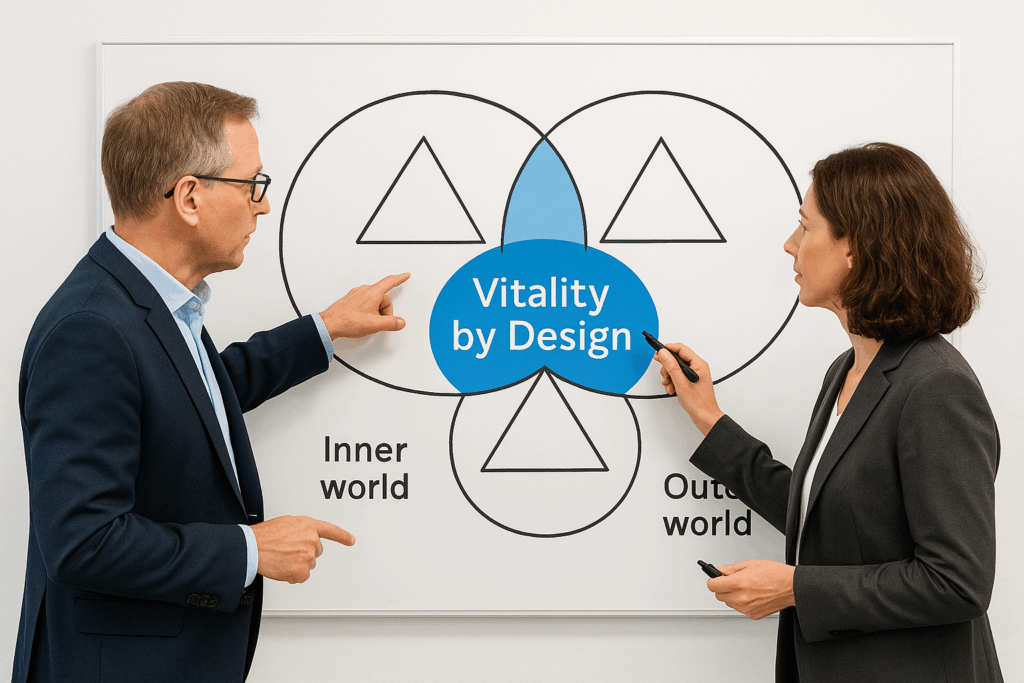
The essence of this design process is alignment. Vitality emerges when the relationships between the organization, its tasks, and its people are internally balanced and mutually reinforcing. Yet vitality also depends on external alignment: when the the organization and its tasks are attuned to the needs, expectations, and support of the surrounding world.
Vitality, therefore, is not only about coherence within the system but also about resonance with its environment. It thrives when there is fit both in the inner organizational triangle and its triangular relation with the outside world.
Implications for Organizations
Embedding vitality as a design principle generates a reinforcing cycle:
- Performance grows as flow fuels creativity, motivation, and productivity.
- Resilience strengthens as adaptability is amplified through alignment.
- Health and sustainability improve, as vitality reduces the risk of illness and disengagement while extending employability.
Vitality by Design is therefore both preventive and generative: it protects against dysfunction while creating the conditions for growth.
Conclusion
Vitality is not a side effect or an HR responsibility. It is the design principle that transforms health and adaptability into lasting performance and resilience. Organizations that embrace Vitality by Design unlock energy, innovation, and sustainability—not by chance, but by conscious design.
Vitality by Design is the future of sustainable performance.