J Health Behav Med Hist 2025-4.
Recognizing Chair Use Disorder – a New Perspective on the Sedentary Epidemic
Robert C. van de Graaf, MD, director
MEDTCC Institute for Health, Behaviour, Medicine and its History, The Netherlands.
Introduction
The concept of Chair Use Disorder (CUD), also known in Dutch as stoornis in het stoelgebruik or in French la maladie de la chaise, emerged organically in my clinical practice as an addiction medicine specialist. Over the past years, I encountered several patients who displayed persistent, compulsive chair use despite negative physical, mental, and social consequences. These patients often showed signs that resembled those seen in substance use disorders: tolerance, withdrawal symptoms, unsuccessful attempts to cut down, and significant functional impairment.
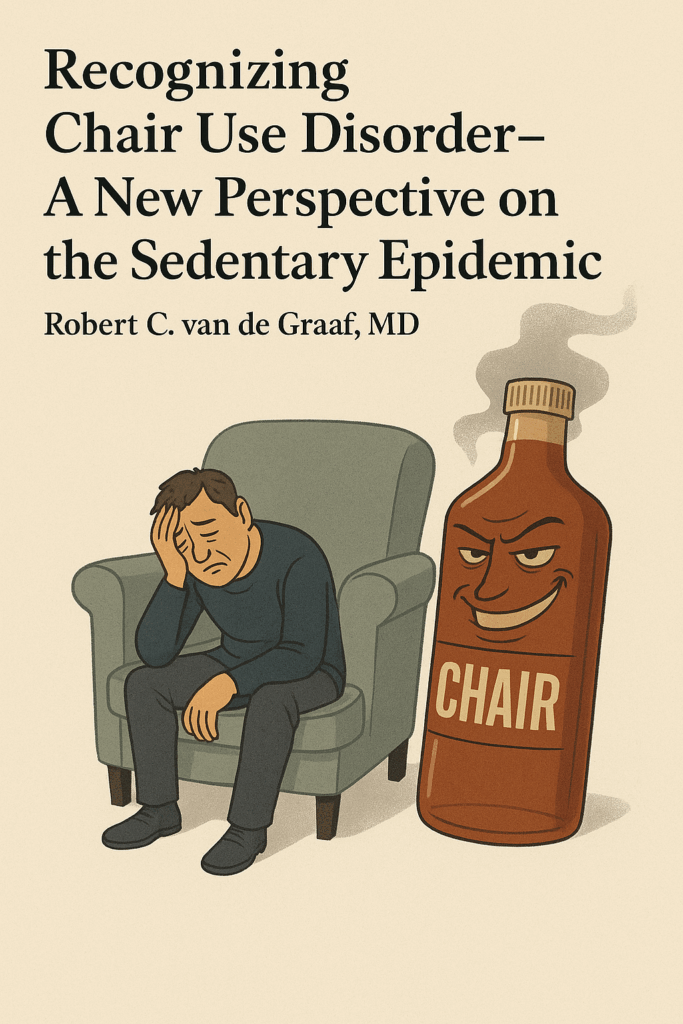
Prompted by these cases, I initiated a diagnostic and therapeutic approach based on addiction frameworks. The results were both surprising and promising—patients responded positively to cognitive behavioral interventions aimed at reducing total daily chair use. Many experienced classic withdrawal symptoms in the early weeks, including discomfort, irritability, fatigue, and restlessness. This convinced me that the behavior we previously framed simply as “sedentary” might in some cases be better understood—and more effectively treated—as an addiction.
To raise awareness of this perspective, I first published a policy-oriented piece in Coincide Magazine [van de Graaf, 2022-1], targeting health professionals, prevention coalitions, and policymakers involved in the Dutch National Prevention Agreement (2018). Around the same time, I gave numerous lectures on Chair Use Disorder (CUD), participated in several podcasts, and was interviewed by media. These public engagements helped to disseminate the concept beyond the clinical setting, sparking discussion among healthcare professionals, researchers, and the general public alike.
This was followed by a short scientific article co-authored with professors Erik Scherder and Leonard Hofstra, published in the Journal of Physical Activity and Health [Van de Graaf, 2022-2], marking the concept’s first step into academic discourse. The idea resonated widely. It was featured in national and international media—including NRC Handelsblad, Radio 1, Belgian and French outlets, The Guardian, BBC, and platforms in South Africa, Denmark and other countries.
As with any new diagnosis, it takes time before society and science fully embrace it. For now, we are in the agenda-setting phase. While many acknowledge that “sitting is the new smoking,” the focus has been too narrow – promoting standing desks and walking breaks as the only alternatives. But the real issue, as I have argued, is not sitting per se, but our overuse of the comfortable chair, a consumer product designed to offer effortless pleasure at the cost of long-term health. Just like with other addictive products, excessive use may lead to chronic disease and social withdrawal.
In this context, we present three responses to articles recently published in Nature Scientific Reports (2024) [Van de Graaf, 2025-1], JAMA Network Open (2024), and Sports Medicine and Health Science (2024). Each reaction reflects on a different dimension of sedentary behavior research, challenging the current biomedical framing and advocating for the integration of addiction-based models into our understanding of and responses to this global health issue.
Together, these reactions aim to broaden the conversation about sedentary behavior by introducing Chair Use Disorder (CUD) as a compelling framework for both clinical care and public health policy.
References
Van de Graaf RC (2022). De meest voorkomende verslaving; we zitten er bovenop maar toch zien we hem niet. Coincide Magazine ‘Samen gezond’ (Mei 2022). https://coincide.nl/de-meest-voorkomende-verslaving-we-zitten-er-bovenop-maar-toch-zien-we-hem-niet-robert-van-de-graaf/
Van de Graaf RC (2022). Van de Graaf RC, Hofstra L, Scherder EJA. Chair use disorder. We should treat excessive chair use as an addiction. J Phys Act Health 2022; 19(7):473. Doi: 10.1123/jpah.2022-0330. https://journals.humankinetics.com/view/journals/jpah/19/7/article-p473.xml
Van de Graaf RC (2025-1) Van de Graaf RC. Commentary (1) on: “Association between long-term sedentary behavior and depressive symptoms in U.S. adults” – Guo et al., (Nature) Sci Rep 2024. J Health Behav Med Hist 2025-5.
Selected Media Coverage on Chair Use Disorder
https://www.bbc.com/reel/video/p0j1883l/champion-sitters-why-the-dutch-sit-too-much