Auteur: Robert C. van de Graaf MD

  • Coaching in practice: the cognitive interaction techniques that make coaching possible

    J Health Behav Med Hist 2025-20

    Coaching in practice: the cognitive interaction techniques that make coaching possible

    Robert C. van de Graaf, MD

    Director, MEDTCC Institute for Health, Behaviour, Medicine and its History, The Netherlands

    Abstract

    This paper presents the third cluster of Interaction Techniques (ITs) within the coaching process: the cognitive techniques that enhance a client’s ability to be coached. Whereas structural ITs provide the framework and relational ITs establish trust, cognitive ITs make comprehension possible. They operate at the intersection of attention, energy, and meaning, helping clients to think clearly, remember, and connect what is being discussed. Drawing on insights from cognitive psychology, neuroscience, and coaching practice, the paper shows that understanding is not passive reception but an active, co-regulated process. Coaching becomes effective not when clients are merely motivated, but when they are mentally available and able to integrate what is offered.

    The silent prerequisite of every session

    In every coaching process there comes a quiet moment of recognition: the client is here—motivated, willing, even trusting—yet somehow unreachable. They listen but do not integrate. They speak but do not connect. Ideas slide off the surface of awareness. What is missing is not willingness, but mental readiness.

    Coaching presupposes the capacity to attend, process, and remember. Yet stress, fatigue, or emotional activation can narrow this space of awareness. When arousal rises, the reflective parts of the brain yield to faster, survival-oriented processing, and comprehension collapses. The client may appear cooperative but is, in essence, cognitively offline.

    Cognitive interaction techniques address precisely this condition. Their purpose is to reopen the channels of thought—to restore access to reasoning, language, and reflection. The coach becomes, in this sense, a facilitator of comprehension: creating the inner silence in which thinking can occur again.

    Coaching as neurocognitive regulation

    Cognitive ITs function through the joint regulation of energy, attention, and information flow. The human brain naturally oscillates between states of focused engagement and diffuse relaxation. A skilled coach senses these rhythms and adjusts pacing, tone, and cognitive demand accordingly.

    Pausing, summarizing, and segmenting reduce unnecessary cognitive load, freeing working memory to focus on meaning rather than form. Using concrete, familiar language anchors abstract ideas within the client’s own network of experiences. Visual metaphors engage both verbal and visual pathways, enriching understanding through multiple channels.

    These techniques are not didactic extras but neuroregulatory interventions. By reducing uncertainty and mental overload, they calm emotional reactivity, re-engage reflective processing, and restore the neural conditions in which thought can re-emerge.

    The comprehension principle

    Every coaching dialogue begins with a simple but profound question: does the client truly understand you?

    Understanding is not the same as hearing. Words may reach the ear yet never land in the mind. True comprehension arises only when what is said fits the client’s own rhythm, language, and mental space. The art of coaching lies in meeting the client where their mind can follow.

    When too much is offered, or when ideas move faster than thought can keep up, the bridge of meaning collapses. The client does not resist; their mind simply loses grip. Clarity then becomes an act of care—slowing down, shaping information gently, and leaving space for it to settle.

    A skilled coach listens for the moment when understanding falters and restores it through presence, simplicity, and imagery. They translate the abstract into the familiar, the complex into the tangible. They know that comprehension is not a technical act but a shared one—an exchange of attention that builds trust through clarity.

    When coach and client think together at the same pace, language becomes connection, and understanding itself becomes the intervention. In that space, coaching turns from instruction into discovery—two minds finding meaning in rhythm.

    From confusion to coherence

    Confusion is not failure; it is the raw material of learning. The brain reorganizes what it already knows to integrate what is new—but only when information is both safe and comprehensible. Cognitive ITs create that bridge: they reduce complexity to a rhythm the mind can follow.

    When a coach paraphrases, connects fragments, or illustrates an idea, they are not simplifying reality—they are translating it into a form the brain can recognize. Coherence feels rewarding because the mind experiences order as relief. The moment a client says, “Now I see what you mean,” is more than metaphor; it marks a physiological shift. Posture softens, breathing steadies, eyes refocus. Insight becomes embodied.

    The energetic dimension of cognition

    Attention is energy. Every distraction, worry, or inner monologue consumes it. Cognitive ITs therefore act as subtle regulators of that energy—through breathing, pacing, and focused summarizing that restore internal balance.

    The coach’s voice, rhythm, and tempo guide the body as much as the mind. A calm pace invites safety; silence allows the nervous system to reset. In those pauses, curiosity replaces defense, and energy once spent on vigilance becomes available for understanding.

    Cognitive clarity is therefore not only intellectual but vital. When clients understand, they regain coherence—and coherence feels like strength. The brain experiences order as efficiency, and efficiency as ease. To feel “lighter” after a session is not metaphorical but physiological: the system has re-organized itself.

    Thinking together: cognition as relationship

    Although cognitive ITs focus on mental processing, they remain relational at heart. Thinking is a social act. The attentive presence of another organizes thought, stabilizes attention, and quiets noise. When a coach mirrors a client’s reasoning, understanding deepens through synchrony.

    This is not instruction but co-creation. Two nervous systems align, two minds build meaning together. Understanding becomes a shared construction—an embodied dialogue rather than a transfer of knowledge. In this way, cognition itself becomes relational: thought emerges not inside one brain, but between two.

    Clarity as care

    Clarity is more than a cognitive virtue; it is a moral stance. To insist on being understood is to honor the client’s mind. In a culture addicted to speed and abstraction, cognitive ITs slow the tempo and affirm that thinking deserves time.

    When coaches practice clarity, they model a rare form of respect—teaching that reflection and precision are not luxuries but essentials of care. Cognitive coaching thus restores both personal attention and collective sanity: it heals the modern fatigue of thought.

    Conclusion

    Cognitive interaction techniques form the silent infrastructure of effective coaching. They restore mental clarity, emotional calm, and attentional focus—the prerequisites for insight and change. While structural ITs provide the framework and relational ITs build trust, cognitive ITs make understanding possible.

    When a client leaves saying, “Now I understand what’s happening,” comprehension has occurred—not through persuasion but through alignment. The coach has not imposed knowledge but reopened the conditions in which knowledge can arise. That, more than any technique or tool, is the essence of coaching: thinking made possible.

    References

    Dijkstra A, Van de Graaf RC, Kootstra Y. Hét praktijkboek voor de leefstijlcoach. Evidence-based technieken voor langdurige leefstijlverandering. Academie coaching en leefstijl 2025.

  • Coaching in practice: the motivational interaction techniques that enhance the willingness to be coached

    J Health Behav Med Hist 2025-21

    Coaching in practice: the motivational interaction techniques that enhance the willingness to be coached

    Robert C. van de Graaf, MD

    Director, MEDTCC Institute for Health, Behaviour, Medicine and its History, The Netherlands

    Abstract

    This paper introduces the fourth cluster of Interaction Techniques (ITs) in coaching: the motivational techniques that enhance a client’s willingness to be coached. Whereas cognitive ITs prepare the mind to understand, motivational ITs prepare the relationship to engage. They do not target behaviour change directly, but optimize the client’s openness, curiosity, and trust toward the coaching process itself. By aligning the process with personal meaning and psychological safety, these techniques make it possible for Behaviour Change Techniques (BCTs) to work. The willingness to be coached is the bridge between relational connection and behavioural influence — the condition that allows change to begin.

    Coaching begins where willingness starts

    Before any technique can be applied, a more basic question must be answered: Is the client willing to be coached — by you, in this way, at this moment?

    This form of willingness is often mistaken for motivation to change. Yet the two are distinct. A person may want to change but resist being guided, just as another may not yet know what they want to change but feel deeply open to reflection. The first will struggle to follow through; the second may progress rapidly once a trusting coaching relationship is in place.

    Motivational interaction techniques [Dijkstra, et al., 2025] work in this space between intention and cooperation. They enhance the coachable state: a mental and emotional readiness to enter the coaching process, to listen, to explore, and to temporarily share control with another person.

    The coach as regulator of engagement

    Being coached is not a passive act; it requires energy, curiosity, and a sense of safety. Clients who feel defensive, ashamed, or judged are less likely to absorb questions or reflect honestly. The coach’s task is to regulate this state of engagement through subtle interactional choices.

    Tone, pacing, and language all play a role. A coach who communicates calm confidence and genuine interest signals to the client’s nervous system: You are safe here; you can let your guard down. Small gestures of validation — “It makes sense you feel hesitant,” “We’ll take this at your pace” — lower defensiveness and open the door to cooperation.

    Motivational ITs therefore work not by persuading, but by inviting. They help the client feel willing to participate in a process that, by its nature, involves vulnerability.

    The art of positive expectancy

    One of the most effective ways to enhance willingness to be coached is to create positive expectancy — the belief that the process itself will be useful, not only its outcome. When sessions feel structured, personal, and relevant to daily life, clients begin to expect benefit from the interaction. This expectancy activates the brain’s anticipatory reward system, preparing the mind for openness, focus, and trust. Motivational ITs such as personalising, contextualising, and explaining the rationale behind exercises strengthen this confidence, while realistic expectation-setting prevents disappointment. The client starts to see coaching as a partnership that supports rather than evaluates — a process they are willing to enter fully.

    Personalisation and contextualisation: the ownership effect

    A client is more willing to be coached when they recognize themselves in the process. Motivational ITs therefore aim to personalize and contextualize every element of the interaction.

    Personalisation means connecting the coaching trajectory to the client’s unique situation, values, or language. Contextualisation means embedding it in the reality of their daily life, so that the conversation feels relevant rather than abstract.

    These small adjustments have a profound effect. When a client hears their own words echoed back in the coach’s framing — “So for you, this is really about having more energy at work” — they feel ownership of the process. Ownership generates commitment. The coach is no longer an authority, but an ally.

    Regulating expectations and emotions

    Clients often enter coaching with mixed feelings: curiosity mingled with skepticism, hope shadowed by fear. If these emotions remain unspoken, they become silent barriers to engagement. Motivational ITs invite them to the surface.

    By openly discussing expectations (“What would make this time together useful for you?”), the coach transforms anxiety into collaboration. By normalizing uncertainty, the coach removes the pressure to perform. The client no longer feels evaluated, but accompanied.

    This emotional regulation is the hidden foundation of coachability. When tension drops, listening improves, and reflection becomes possible. The willingness to be coached is not created through pressure, but through presence.

    The difference between being convinced and being invited

    Traditional approaches to motivation often rely on persuasion: convincing the client that change is necessary. But persuasion targets behaviour, not relationship. Motivational interaction techniques take the opposite route: they focus first on relationship, trusting that change will follow from cooperation.

    To be willing to be coached is to feel invited into a joint exploration. The coach does not stand above the client but beside them, co-constructing meaning. The interaction shifts from I’ll tell you how to let’s discover how. This shift is subtle yet transformative — it changes the emotional geometry of the relationship.

    The relational neuroscience of willingness

    From a neurobiological perspective, the willingness to be coached emerges when the social brain detects safety and value. The ventromedial prefrontal cortex integrates relational trust with self-relevance: Is this person safe? Is this process meaningful to me?

    Motivational ITs operate exactly here. They combine signals of trust (warmth, predictability, respect) with cues of personal relevance (individualized framing, clear rationale). When both are present, the client’s brain lowers its guard, allowing learning and behavioural influence to occur.

    Without this foundation, even the most sophisticated behaviour change techniques remain inert. The relational channel through which they would operate stays closed.

    From cooperation to collaboration

    The ultimate goal of motivational interaction techniques is not obedience but collaboration. A cooperative client complies; a collaborative client participates. The difference determines whether coaching produces temporary adaptation or lasting insight.

    By continually aligning the process with the client’s values and rhythm, the coach helps transform external guidance into internal drive. The client becomes a co-owner of the process, and the coaching space evolves from instruction to co-creation.

    This is the essence of being coachable: not passivity, but active participation in one’s own learning under the guidance of another.

    Conclusion

    Motivational interaction techniques are the social and psychological catalysts of coachability. They do not aim to change behaviour directly but to make behaviour change possible. By enhancing the client’s willingness to be coached, they prepare the ground on which all later techniques can take root.

    Structure provides safety. Relationship builds trust. Cognition enables understanding. But only motivation to be coached turns these elements into a living process.

    When a client leaves a session saying, “I look forward to next time,” the motivational ITs have done their work. The door to influence is open — and through that door, the art of behavioural change can finally begin.

    References

    Dijkstra A, Van de Graaf RC, Kootstra Y. Hét praktijkboek voor de leefstijlcoach. Evidence-based technieken voor langdurige leefstijlverandering. Academie coaching en leefstijl 2025.
  • Coaching in practice: The relational interaction techniques that shape the alliance

    J Health Behav Med Hist 2025-19

    Coaching in practice: The relational interaction techniques that shape the alliance

    Robert C. van de Graaf, MD

    Director, MEDTCC Institute for Health, Behaviour, Medicine and its History, The Netherlands

    Abstract

    This second paper in the series on Interaction Techniques (ITs) explores the relational dimension of coaching. While structure provides clarity and direction, relationship provides safety and trust. Relational interaction techniques shape the emotional and communicative field in which behavioural change becomes possible. Integrating insights from coaching, psychotherapy, and communication theory, the paper argues that relationship is not a personality trait or coincidence but a set of learnable professional actions that sustain connection, regulate tension, and transform dialogue into alliance.

    Introduction: relationship as context

    Coaching is often described in terms of questions, models, and interventions. Yet beneath these visible techniques lies something quieter and more powerful: the relationship between coach and client. It is within this relational space that safety arises, reflection deepens, and new behaviour takes root. A well-designed structure may create order, but relationship gives it life.

    Relational interaction techniques form the second cluster in the model of effective coaching interactions [Dijkstra, et al., 2025]. They focus on the quality of the connection—how coach and client meet, listen, and respond to each other. Just as structural ITs provide the external framework, relational ITs provide the emotional framework: the felt sense of safety, mutual respect, and shared purpose that underpins the coaching process.

    Relationship as the medium of change

    The relationship between coach and client is not an accessory to the process—it is the process. Change occurs through interaction, and every interaction carries emotional and cognitive meaning. When trust is present, clients explore more freely, tolerate discomfort better, and engage more deeply in reflection. When trust is absent, defensiveness rises and learning collapses.

    Research across helping professions consistently shows that the quality of the working alliance is among the strongest predictors of success. This alliance rests on three interdependent elements: bond (emotional trust and empathy), goal (shared purpose), and task (collaboration on agreed activities). Relational ITs sustain these elements through deliberate, moment-to-moment action.

    They are not abstract attitudes such as “being nice” or “showing interest,” but professional behaviours—forms of listening, attunement, and presence that translate goodwill into reliability and empathy into safety. Relationship, in this view, is an active practice rather than a passive state.

    The function of relational interaction techniques

    Relational ITs regulate the emotional and communicative field in which all other techniques operate. Their effects can be understood on three levels.

    Creating safety

    At the foundation of every coaching relationship lies psychological safety. Clients must feel accepted, respected, and seen before they can take risks. Relational ITs establish this safety not by promise but by consistency: the coach’s tone, timing, and responsiveness signal reliability. Safety allows the nervous system to relax, making curiosity and openness possible.

    Maintaining Connection

    As the process unfolds, tensions naturally emerge. Doubt, frustration, or ambivalence are part of change. Relational ITs maintain connection through these moments by modulating emotional intensity, recognising resistance, and preventing rupture. Connection is not the absence of tension but the ability to stay in contact while navigating it.

    Enabling Influence

    Once safety and connection are established, the relationship becomes a medium of influence. The client allows themselves to be guided, confronted, or challenged precisely because the relational foundation has proven trustworthy. Through this channel, behaviour change techniques can do their work effectively. Without it, even the most powerful BCTs lose traction.

    Thus, relational ITs are not about warmth or empathy alone—they are about effectiveness. They transform coaching from a series of conversations into a living system of co-regulation and collaboration.

    Relational presence and professional distance

    Relational work requires both closeness and distance. Too much closeness risks over-identification; too much distance creates detachment. Relational ITs guide coaches in maintaining this balance.

    Professional warmth is not the same as personal involvement. It means being emotionally available while maintaining clear boundaries around the coaching role. Clients sense authenticity in this balance: the coach is fully present but not absorbed, empathic yet steady. This allows emotions to emerge safely without overwhelming either party.

    Relational ITs thus sustain both connection and containment—holding the emotional field of the conversation within respect and steadiness. The relationship becomes a vessel strong enough to contain complexity, resistance, and insight.

    From rapport to alliance

    Many beginning coaches equate a good relationship with pleasant rapport—a sense of comfort or friendliness. But rapport alone is not enough. The coaching alliance is more than liking each other; it is a working partnership built on equality, honesty, and shared purpose.

    Relational ITs move the relationship beyond comfort toward collaboration. Through transparency, reflection, and attuned communication, the coach invites shared ownership of the process. Responsibility becomes mutual: both contribute to direction, both can voice discomfort, both adjust the course.

    This shift from rapport to alliance marks the transition from personal connection to professional effectiveness. It turns conversation into cooperation and empathy into agency.

    The neurobiology of connection

    The effectiveness of relational ITs is rooted in the body as much as in the mind. Human communication is a biological process of co-regulation: tone, eye contact, and posture signal safety or threat long before words are processed.
    When a coach listens with genuine presence, the client’s nervous system perceives calm. The parasympathetic system activates, and cognitive functions—reflection, problem-solving, creativity—become accessible again.

    This is why relational ITs cannot be faked. Clients respond not only to content but to signal. Authenticity matters because the body recognises congruence. The coach’s grounded presence, consistent timing, and attuned rhythm create a physiological environment in which change can occur. Relational work is therefore both psychological and biological: it allows the client’s system to move from defence to openness.

    The coach as relational instrument

    If structure is about designing the space, relationship is about inhabiting it. The coach becomes the primary instrument of interaction. Every gesture, pause, and expression shapes the atmosphere.

    Relational competence requires self-awareness. Coaches must observe and regulate their own emotional responses in real time. This reflexive capacity—to stay centred while attending to another—is not innate but trainable, developing through reflection, supervision, and experience.

    Mature coaches read not only what clients say but how they say it—the tempo, tone, and micro-expressions that reveal underlying states. Responding appropriately to these cues integrates empathy with discernment and transforms listening into influence.

    Relationship within the broader interactional context

    Like structure, relationship cannot stand alone. The four clusters of interaction techniques are interdependent. Structure gives shape; relationship gives warmth; motivation provides energy; ability ensures focus and readiness.

    Without structure, relationship drifts into sentimentality. Without relationship, structure becomes mechanical. Together they form the lower foundation of the coaching process—the physical and emotional architecture in which motivation and ability can develop.

    Relational ITs do not replace structure; they animate it. They transform a designed space into a lived space—a place where trust and collaboration can take form.

    Conclusion: connection as craft

    Coaching succeeds not only because of the tools it uses but because of the quality of the space between people. Relational interaction techniques shape that space. They create trust, sustain connection, and transform dialogue into alliance.

    For the beginning coach, the lesson is simple but profound:
    relationship is not something you have—it is something you do.

    Every interaction, from the first greeting to the last reflection, is an opportunity to strengthen or weaken the alliance. The coach’s task is to cultivate relational presence as deliberately as any other technique—with awareness, practice, and care.

    Just as structure provides the skeleton of coaching, relationship provides its heartbeat. Together, they form the living foundation upon which motivation and ability to be coached can thrive.

    References

    Dijkstra A, Van de Graaf RC, Kootstra Y. Hét praktijkboek voor de leefstijlcoach. Evidence-based technieken voor langdurige leefstijlverandering. Academie coaching en leefstijl 2025.

  • Coaching in Practice: Designing the coaching space: structure as the foundation of effective interaction

    J Health Behav Med Hist 2025-18.

    Coaching in Practice: Designing the coaching space: structure as the foundation of effective interaction

    Robert C. van de Graaf, MD, director

    MEDTCC Institute for Health, Behaviour, Medicine and its History, The Netherlands.

    Abstract

    This paper introduces the concept of interaction techniques (Its) as the foundation of effective coaching. While behaviour change techniques (BCTs) shape what clients do, interaction techniques determine how change becomes possible. Focusing on the first cluster — Design of the Trajectory — the paper shows how structure provides safety, clarity, and sustainability within the coaching relationship. Integrating insights from coaching and psychotherapy research, it argues that structure is not administrative background work but the invisible scaffolding that allows coaching to succeed.

    A beginning coach walks into her first session.

    She is eager, full of questions, and ready to inspire. Yet as the conversation unfolds, it drifts without a clear beginning or end. Time slips away, the session overruns, and the client leaves uncertain about what has been achieved or what to expect next time. The coach, too, feels the lack of impact. What was missing was not energy or goodwill, but structure.

    When people think of coaching, they often picture meaningful dialogue, powerful questions, or practical tools for behaviour change. These are the behaviour change techniques (BCTs): the visible actions that directly influence what clients do. Yet BCTs cannot function in isolation. They require a holding space — a framework that shapes, supports, and directs the process. That holding space is created through interaction techniques (ITs).

    The interactional context of coaching

    Interaction techniques do not directly change behaviour. Instead, they create the interactional context in which behaviour change becomes possible. In the literature, they are often referred to as modes of delivery or common factors. In one of my earlier books we called them intervention techniques (Dijkstra, et al., 2025). Here, however, I prefer the term interaction techniques, since these techniques focus on creating an optimal interactional context in which behaviour change techniques (BCTs) can be effective.

    They are techniques because each has a specific purpose, clear characteristics, and natural boundaries. Crucially, they can be learned, practiced, and mastered, just like BCTs.

    Interaction techniques can be grouped into four essential clusters:

    1. Design of the Trajectory — the structural dimension of coaching: how sessions and processes are designed, monitored, and adjusted.
    2. Optimizing the Relationship — the relational dimension: building trust, safety, and alliance between coach and client.
    3. Strengthening Motivation — the motivational dimension: fostering the client’s willingness to engage in the process.
    4. Supporting the Ability to Be Coached — the cognitive and energetic dimension: ensuring the client has the presence, focus, and energy to benefit from coaching.

    These clusters do not compete with behaviour change techniques — they enable them. Without structure, relationship, willingness, and ability, even the most sophisticated BCTs will fall flat. Coaching is never just about tools for change; it is about cultivating the conditions in which change can thrive.

    The structural dimension: design of the trajectory

    This paper focuses on the first cluster: Design of the Trajectory. Structure is not administrative background work but a set of concrete techniques that together form the scaffolding of effective coaching.

    Some of these techniques are applied in advance, before the coaching begins or at the start of a session. They include the intake assessment, agreements about frequency and duration, decisions about location and setting, clarity around communication channels and financial arrangements, the use of materials and media, agreements about reporting, and criteria for referral when coaching is not sufficient. At the session level, structure also involves setting a joint agenda and monitoring time.

    Other techniques are applied along the way. Continuous assessment is central here: an ongoing evaluation of progress, satisfaction, and readiness. This allows the coach to make thoughtful adjustments to the trajectory or to a single session — always within the boundaries agreed upon.

    Finally, structure also matters in the moment. Coaching conversations are dynamic and often unpredictable, and the coach must constantly decide which techniques — both interactional and behavioural change — to use at a given time. This selection and timing is itself a structuring skill, giving coherence to the dialogue and clarity to the process. Continuous assessment plays a cross-cutting role here, informing decisions at every level.

    Boundaries and sustainability

    Every structuring technique has its boundaries. For the client, these boundaries provide clarity and safety: they know what coaching can and cannot offer. For the coach, boundaries ensure sustainability: coaching must remain feasible in terms of time, energy, scope of expertise, and financial viability. Beginning coaches are often tempted to be endlessly available, but professionalism requires discipline.

    Structure means knowing both what is possible and what is not — it is compassion with boundaries.

    Why structure matters?

    Experience in practice, supported by insights from coaching research, shows that structure makes a decisive difference. When coach and client agree in advance on the process and its goals, clients feel more focused and progress comes more naturally. A well-structured alliance gives both parties clarity about expectations and keeps the work on track. Regular check-ins on progress strengthen engagement and make it easier to adapt the approach when needed.

    The most effective coaching trajectories are those built on a clear framework — one that combines stability with enough flexibility to respond to the client’s evolving needs.

    Structure within the broader interactional context

    Although this paper has focused on the structural dimension, structure cannot stand alone. The four clusters of interaction techniques are deeply interdependent, each balancing and reinforcing the others. Structure on its own may bring order, but without relationship it becomes cold and rigid. Relationship without structure may feel warm but risks dissolving into endless talk without direction. Motivation provides energy, yet without the ability to be coached it quickly turns into frustration. Ability provides focus and readiness, but without motivation it becomes passive and inert.

    Real behavioural change requires the integration of all four dimensions. Only when structure, relationship, motivation, and ability are cultivated together does the interactional context become strong, safe, and flexible enough to support effective coaching.

    Conclusion: interaction is everything

    Coaching is often described in terms of methods, tools and techniques for change. But these only work when the interactional context is properly designed. The structuring techniques of the Design of the Trajectory cluster form the hidden foundation: they create safety, clarity, and sustainability. Relationship techniques add trust, motivational techniques generate willingness, and ability-focused techniques ensure that clients are cognitively and emotionally ready to benefit.

    For beginning coaches, the key message is this: mastering interaction techniques is just as important as mastering behaviour change techniques. Without them, the process falters. With them, coaching becomes not only possible but powerful.

    Coaching is not only what you do with a client — it is how you shape the space between you and the client. That space — the interactional context — is where change truly begins.

    References

    Dijkstra A, Van de Graaf RC, Kootstra Y. Hét praktijkboek voor de leefstijlcoach. Evidence-based technieken voor langdurige leefstijlverandering. Academie coaching en leefstijl 2025.

  • Coaching in Context: Structure as the Foundation of the Interactional Space

    J Health Behav Med Hist 2025-18

    Coaching in Context: Structure as the Foundation of the Interactional Space

    Robert C. van de Graaf, MD, director

    MEDTCC Institute for Health, Behaviour, Medicine and its History, The Netherlands.

    A beginning coach walks into her first session. She is eager, full of questions, and ready to inspire. Yet as the conversation unfolds, it meanders without a clear beginning or end. Time slips away, the session overruns, and the client leaves unsure what has been achieved—or what to expect next time. The coach, too, feels the lack of impact. What was missing was not energy or goodwill, but structure.

    When people think of coaching, they often picture meaningful dialogue, powerful questions, or practical tools for behaviour change. These are behaviour change techniques (BCTs): the visible interventions that directly shape what clients do. But BCTs do not operate in a vacuum. They require a holding space—a framework that shapes, supports, and directs the process. This holding space is created through interaction techniques.

    The Interactional Context of Coaching

    Interaction techniques do not directly change behaviour. Instead, they shape the interactional context—the relational and structural space within which behavioural change can take root. In the literature, these techniques are sometimes referred to as modes of delivery or common factors. In an earlier publication (Dijkstra et al., 2025), we called them intervention techniques, but here the term interaction techniques is more precise.

    They are called techniques because each serves a distinct purpose, has identifiable characteristics, and operates within clear boundaries. Crucially, they are skills that can be learned, practised, and mastered, just like behaviour change techniques (BCTs).

    Interaction techniques can be grouped into four essential clusters:

    • Design of the Trajectory → the structural dimension: how sessions and processes are designed, monitored, and adjusted.
    • Optimizing the Relationship → the relational dimension: building trust, safety, and alliance between coach and client.
    • Strengthening Motivation → the motivational dimension: fostering the client’s willingness to engage in coaching.
    • Supporting the Ability to Be Coached → the cognitive and energetic dimension: ensuring the client has the presence, focus, and energy to benefit.

    These clusters do not compete with BCTs; they make BCTs work. Without structure, relationship, motivation, and ability, even the most sophisticated behavioural techniques are likely to fall flat. In fact, when interaction techniques are applied poorly—or neglected altogether—the coaching conversation may never truly take shape.

    Imagine a coach who dives straight into setting action goals (a BCT) without first clarifying the session agenda or establishing trust. The client nods politely but feels uneasy and unfocused. Halfway through the session, time runs out, and both leave with a vague sense of unfinished business. The problem isn’t the goal-setting technique itself; it’s the absence of a solid interactional context to hold it.

    The Structural Dimension: Designing the Trajectory

    This paper focuses on the first cluster of interaction techniques: Design of the Trajectory. Structure is far more than administrative background work. It consists of a series of concrete techniques that together form the scaffolding of effective coaching. Good structure gives coaching its shape, direction, and rhythm—before, during, and between sessions.

    1. Before the coaching starts
    Structural techniques applied in the preparatory phase lay the foundation for a safe and focused process. They include the intake assessment, where goals, context, and expectations are explored, and clear agreements about frequency, duration, location, and practical arrangements. Decisions are also made regarding communication channels, financial agreements, the use of materials and media, and reporting and confidentiality. Finally, referral criteria are established for situations in which coaching is not appropriate or sufficient.
    These preparatory techniques create a shared framework that clarifies what coaching involves and where its boundaries lie.

    2. At the session level
    Once coaching begins, structure becomes visible through techniques such as agenda-setting, time management, and framing the session. Together, coach and client define what will be discussed, agree on priorities, and monitor progress within the available time. These simple but powerful techniques prevent sessions from drifting, ensure that key topics are addressed, and help both parties keep track of their work together.

    3. Along the way
    Effective coaching trajectories require continuous assessment—a recurring evaluation of progress, satisfaction, and readiness for change. This technique allows the coach to make thoughtful adjustments to the coaching plan or to an individual session, always within the agreed boundaries. Evaluation moments can be brief check-ins at the end of each session, structured mid-term reviews, or more informal reflections. Regular feedback loops strengthen alignment and shared ownership of the process.

    4. In the moment
    Finally, structure also operates within the conversation itself. Coaching dialogues are often dynamic and unpredictable. The coach must continuously decide which interactional and behavioural techniques to use, and when. This real-time structuring—sometimes called process steering—involves guiding the flow of the conversation, maintaining focus, pacing interventions, and making deliberate choices about when to deepen, redirect, or close a topic. Continuous assessment plays a cross-cutting role here, informing decisions at every level of the trajectory.

    Consider a coach who begins each trajectory with a thorough intake and clear agreements. Each session starts with a jointly defined agenda and ends with a brief check-in. Midway, coach and client review progress and adjust the plan. During sessions, the coach actively steers the process, ensuring focus and flow. This structured approach creates clarity, builds trust, and allows behavioural techniques to land effectively.

  • The Six-Animal Zoo: An Evolutionary Map of Human Motivation

    J Health Behav Med Hist 2025-17.

    The Six-Animal Zoo: An Evolutionary Map of Human Motivation

    Robert C. van de Graaf, MD, director

    MEDTCC Institute for Health, Behaviour, Medicine and its History, The Netherlands.

    Abstract

    Human behaviour is shaped by a set of deeply rooted motivational systems, sculpted by evolutionary pressures over millions of years. The Six-Animal Zoo in our Brain model offers a clear, accessible way to understand this complex landscape. It identifies six core motivational forces—the Comfort Seeker, Belonger, Creature of Habit, Explorer, Meaning Maker, and Striver—and groups them into two functional metaphorical layers: basic drives and higher drives. Together, these systems interact dynamically to guide how humans navigate safety, connection, routine, exploration, purpose, and ambition. This paper outlines the evolutionary foundations of the model, explains the interaction between these six forces, and illustrates its practical applications in coaching, leadership, and behavioural change. By mapping the motivational “zoo” within us, we gain a powerful lens for understanding and influencing human behaviour.

    Introduction: Why Map Human Motivation?

    Human behaviour often appears unpredictable on the surface, yet beneath this complexity lie a set of stable motivational patterns. These patterns evolved to help our ancestors survive, reproduce, and thrive in dynamic social and ecological environments.

    Today, these same motivational systems shape our everyday lives—at work, in relationships, in personal growth—but they often do so outside conscious awareness. We feel their pull in competing urges: to rest or achieve, to belong or explore, to stick with what we know or to seek change.

    The Six-Animal Zoo in our Brain model provides a simple yet powerful metaphor for this inner landscape. By picturing six motivational “animals” living within us, each with its own evolutionary agenda, we can observe how their interplay drives our behaviour. Rather than seeing human motivation as linear or unitary, the Zoo model presents it as a dynamic ecosystem.

    Evolutionary Foundations of the Six Animals

    Across evolutionary history, humans faced recurring adaptive challenges: finding safety, building alliances, learning from changing environments, creating shared meaning, and navigating social hierarchies. Natural selection shaped specialised motivational systems to meet these challenges.

    The Six-Animal Zoo represents six such clusters of motivational drives:

    • Comfort Seeker
      Focused on safety, rest, and physiological stability. It regulates basic needs and threat avoidance, ensuring survival in uncertain environments.
    • Belonger
      Motivated by social bonding and group belonging. For social mammals like humans, inclusion provided protection and resources; exclusion could be fatal.
    • Creature of Habit
      Ensures behavioural stability through repetition and efficiency. Habits conserve energy, reduce cognitive load, and make behaviour predictable.
    • Explorer
      Fuels curiosity, learning, and adaptation. Exploration allowed humans to discover resources, innovate, and adjust to changing climates and contexts.
    • Meaning Maker
      Creates narratives, shared values, and cultural frameworks that give life coherence and direction. This drive underpins morality, identity, and symbolic thinking.
    • Striver
      Pursues ambition, achievement, and social status. In ancestral societies, higher status improved access to mates, allies, and resources, making striving an adaptive force.

    These animals are not literal brain modules but metaphors for interacting motivational systems—patterns of behaviour, emotion, and cognition that emerged from evolutionary pressures.

    Two Functional Layers

    The six animals can be organised into two functional ‘layers’:

    • Basic drives: Comfort Seeker, Creature of Habit, Belonger
      These drives are evolutionarily older and shared with other mammals. They focus on immediate survival, stability, and social integration.
    • Higher drives: Explorer, Meaning Maker, Striver
      These emerged later in human evolution and build on the basic layer. They enable exploration, culture, and ambition—capacities that define much of human uniqueness.

    This layered structure is not strict but helps explain tensions and synergies. The lower layer provides stability and safety, while the upper layer enables growth and transformation.

    Interactions and Tensions

    Human motivation arises not from single drivers, but from the interaction between animals. These interactions can be cooperative or conflicting:

    • Striver vs. Comfort Seeker
      The classic tension between ambition and rest. Unchecked striving risks burnout; excessive comfort leads to stagnation.
    • Belonger vs. Explorer
      Social belonging can either support exploration (through encouragement and shared adventure) or restrain it (through fear of exclusion).
    • Habit vs. Explorer
      Habit provides stability, but can resist needed change. Exploration drives novelty, sometimes disrupting routine.
    • Striver and Meaning Maker
      Ambition aligned with purpose can generate profound impact. Ambition without meaning often leads to dissatisfaction or shallow success.

    Balanced motivation occurs when these forces shift dynamically, allowing different animals to lead depending on context. Imbalance arises when one dominates persistently—for example, an overactive Striver crowding out rest and belonging, or an overindulged Comfort Seeker dampening ambition and growth.

    Practical Applications of the Zoo Model

    The Six-Animal Zoo in our Brain model is not only a conceptual framework but also a practical tool for reflection, coaching, leadership, and behaviour change.

    Making Motivation Visible

    The Zoo metaphor helps individuals recognise inner dynamics that are often vague or unconscious. A conflict like procrastination, for instance, may reflect a tug-of-war between Comfort Seeker and Striver, rather than “laziness.”

    Integrating Rather Than Suppressing

    Many change strategies focus on strengthening one motive and suppressing another. The Zoo model encourages integration: giving quieter animals a voice and moderating dominant ones. This leads to more sustainable behaviour change.

    Tailoring Interventions

    Different people exhibit different motivational constellations. Some are driven by Striver and Explorer; others lean heavily on Habit and Comfort. Mapping these patterns supports personalised coaching strategies, therapeutic insights, and leadership development.

    Team and Organisational Culture

    The Zoo lens applies not just to individuals but to groups. Some organisations are dominated by Striver dynamics (competitive, ambitious), others by Comfort and Habit (stable but change-resistant). Recognising these patterns can guide cultural shifts, leadership styles, and change initiatives.

    A Shared Language for Human Motivation

    The strength of the Zoo model lies in its clarity and universality. The six animals provide a shared vocabulary for discussing motivation—whether in personal reflection, coaching conversations, or organisational development.

    By mapping the motivational landscape inside individuals and groups, we gain insight into both strengths and vulnerabilities. We can see not just what people do, but why their behaviour emerges from the interplay of evolutionary drives.

    This language allows for more nuanced conversations about change, moving beyond blame or simplistic notions of willpower toward a richer understanding of motivational ecosystems.

    Conclusion

    Human motivation is complex, layered, and often full of inner tensions. The Six-Animal Zoo in our Brain model offers an elegant, evolutionarily grounded way to map this complexity.

    The Comfort Seeker, Belonger, Creature of Habit, Explorer, Meaning Maker, and Striver together form a motivational ecosystem that shapes our daily lives, our ambitions, our relationships, and our capacity for change.

    By understanding and working with these forces—not against them—we can foster healthier individuals, more adaptive teams, and wiser leadership. The Zoo does not simplify human behaviour; it makes its underlying structure visible. And with a good map, navigation becomes far more possible.

    references:

    Van de Graaf RC. The Zoo in Our Brain: An Evolutionary Psychology Framework for Understanding and Coaching Human Behaviour. J Health Behav Med Hist 2025-9.

    Van de Graaf RC. The Six-Animal Zoo: An Evolutionary Map of Human Motivation. J Health Behav Med Hist 2025-17.

  • Introducing the Striver: Completing the Zoo in Our Brain

    J Health Behav Med Hist 2025-16.

    Introducing the Striver: Completing the Zoo in Our Brain

    Robert C. van de Graaf, MD, director

    MEDTCC Institute for Health, Behaviour, Medicine and its History, The Netherlands.

    Abstract

    Human behaviour is guided by multiple evolutionary motivational systems that have shaped our species over millennia. In the original Zoo in Our Brain model, five metaphorical animals were used to represent these core drivers: the Comfort Seeker, the Belonger, the Creature of Habit, the Explorer, and the Meaning Maker. Over time, however, one central motive proved difficult to place: the drive for ambition, influence, and social recognition. This follow-up paper introduces the Striver as the sixth animal, completing the motivational landscape. We explore its evolutionary foundations, its role within the broader system, and its dynamic interactions with the other animals. By making ambition explicit, the Striver allows us to understand a crucial dimension of human motivation that often operates just below the surface.

    Expanding the Zoo

    The Zoo in Our Brain model was developed to bring clarity to the complex web of human motivation through an accessible evolutionary psychological metaphor. Each “animal” represents a cluster of motivational tendencies that have emerged to solve adaptive challenges throughout human history.

    The original five animals [Van de Graaf, 2025] are:

    • the Comfort Seeker, oriented towards safety and physiological stability;
    • the Belonger, focused on social bonding and group cohesion;
    • the Creature of Habit, which supports efficient, automatic functioning;
    • the Explorer, driven by curiosity and novelty seeking; and
    • the Meaning Maker, which creates narratives, purpose, and shared frameworks of understanding.

    Together, these five forces provide a remarkably coherent map of human behavioural tendencies. Yet one recurring theme remained insufficiently represented: our drive to strive—to compete, to rise in status, to achieve, and to leave a mark. These ambitions have played a decisive role in human evolution and cultural development. Recognising their distinct motivational character led to the articulation of a sixth animal: the Striver.

    Expanding the Zoo

    The Zoo in Our Brain model was developed to bring clarity to the complex web of human motivation through an accessible evolutionary metaphor. Each “animal” represents a cluster of motivational tendencies that have emerged to solve adaptive challenges throughout human history.

    The original five animals are:

    • the Comfort Seeker, oriented towards safety and physiological stability;
    • the Belonger, focused on social bonding and group cohesion;
    • the Creature of Habit, which supports efficient, automatic functioning;
    • the Explorer, driven by curiosity and novelty seeking; and
    • the Meaning Maker, which creates narratives, purpose, and shared frameworks of understanding.

    Together, these five forces provide a remarkably coherent map of human behavioural tendencies. Yet one recurring theme remained insufficiently represented: our drive to strive—to compete, to rise in status, to achieve, and to leave a mark. These ambitions have played a decisive role in human evolution and cultural development. Recognising their distinct motivational character led to the articulation of a sixth animal: the Striver.

    The Evolutionary Logic of the Striver

    Ambition is not a modern invention; it is a deep evolutionary force. In early human societies, social status and influence determined access to resources, mates, and protection. Individuals who successfully navigated social hierarchies were more likely to survive and reproduce. Over time, this selective pressure shaped neural systems associated with competitive behaviour, reputation management, and long-term strategic thinking.

    The Striver embodies these motivational systems. It represents the impulse to achieve, influence, and be recognised—not merely for personal gratification, but as a means of securing one’s position within complex social structures. Human ambition operates across multiple domains: material success, intellectual achievement, artistic creation, leadership, and moral influence. In each case, the Striver provides energy and direction for outward impact.

    A Conceptual Map of the Six Animals

    The expanded Zoo can be understood in terms of two functional clusters.

    The basic drives—the Comfort Seeker, the Creature of Habit, and the Belonger—form the evolutionary foundation of human motivation. These systems ensure stability, safety, and social integration. They are shared, in various forms, with many other social mammals and underpin much of our daily behavioural repertoire.

    The higher drives—the Explorer, the Meaning Maker, and the Striver—build on these foundations. They enable distinctively human capacities: exploration and innovation, the creation of meaning and culture, and the pursuit of status and achievement. These higher systems allow individuals to transcend immediate circumstances, imagine alternatives, and shape their environment and social world in unprecedented ways.

    Importantly, these systems do not function independently. They form a dynamic network of interacting motivational forces. Sometimes these interactions are harmonious, as when ambition aligns with social bonds and shared meaning. At other times, tensions arise—for example, when the drive to strive collides with the need for rest, or when exploratory impulses disrupt established habits. It is this dynamic interplay, rather than any single system in isolation, that shapes the diversity and complexity of human behaviour.

    The Striver in Relation to Other Animals

    Within this motivational network, the Striver occupies a distinctive position. It connects deeply human capacities for planning and imagination with social hierarchies and cultural systems of recognition. Its interactions with the other animals illuminate many familiar psychological patterns:

    • Striver and Comfort Seeker: A perennial tension between ambition and rest. Unchecked striving can override recovery needs; excessive comfort can suppress ambition.
    • Striver and Belonger: Ambition unfolds in social contexts. Striving can strengthen group identity through leadership and contribution, but can also generate competition and social strain.
    • Striver and Creature of Habit: Habits provide the stable routines that sustain ambition over time, but rigid patterns can inhibit growth and change.
    • Striver and Explorer: Exploration fuels innovation and reputation, yet unbridled novelty seeking can scatter ambition and dilute focus.
    • Striver and Meaning Maker: When ambition is integrated with purpose, it becomes a constructive force for cultural and personal development; when disconnected, it risks becoming shallow or self-serving.

    These interactions reveal why the Striver is indispensable to a complete picture of human motivation. It acts as both a catalyst and a destabiliser—driving progress while generating tensions that must be managed by the whole motivational system.

    Towards a More Complete Motivational Landscape

    By introducing the Striver, the Zoo in Our Brain model reaches greater conceptual completeness. The six animals together represent a balanced set of evolutionary motives that underlie human behaviour:

    • three foundational systems that secure safety, stability, and belonging, and
    • three higher systems that enable exploration, meaning making, and striving.

    Understanding human behaviour through this lens highlights that no single driver is inherently positive or negative. Each can be adaptive or maladaptive depending on context and its relation to the others. Ambition, in particular, has often been treated as either a virtue or a vice, depending on cultural framing. The Zoo model instead treats it as a neutral but powerful evolutionary force—one that must be integrated rather than ignored.

    Conclusion

    The addition of the Striver enriches the Zoo in Our Brain framework by illuminating a central dimension of human motivation: the desire to achieve, influence, and be recognised. This drive has deep evolutionary roots and plays a pivotal role in shaping human culture, social structures, and individual life courses.

    By viewing ambition as one of six interacting motivational forces, rather than as a standalone trait, we gain a clearer and more balanced perspective on human behaviour. The Zoo model does not prescribe solutions; it offers a conceptual map for understanding the dynamic tensions that animate our inner world. With the Striver in place, that map becomes more complete.

    References

    Van de Graaf RC. The Zoo in Our Brain: An Evolutionary Psychology Framework for Understanding and Coaching Human Behaviour. J Health Behav Med Hist 2025-9.

  • Coaching at Your Fingertips: A Practical Framework for Everyday Self-Management

    J Health Behav Med Hist 2025-15.

    Robert C. van de Graaf, MD, director
    MEDTCC Institute for Health, Behaviour, Medicine and its History, The Netherlands

    Coaching at Your Fingertips: A Practical Framework for Everyday Self-Management

    Abstract

    Self-management benefits from tools that are simple, memorable, and always available. This paper introduces a method that uses the human hand as a lifelong self-coaching framework. Each finger represents one guiding question: (1) What do I do well? (2) Where do I want to go? (3) What do I want to let go of? (4) What do I want to remain loyal to? (5) Where do I want to grow? By sequentially raising each finger and answering its question, individuals create a cycle of reflection and action. This paper presents the method and illustrates its application through case vignettes involving a teenager, a manager, and a patient. The method demonstrates that effective self-coaching can literally be practiced at one’s fingertips.

    Introduction

    Self-management is often described as the ability to reflect, make choices, and act in alignment with personal goals and values. Coaching and mentoring help people develop these skills, but many situations require immediate reflection without external support. In such moments, simple and memorable self-coaching methods can make a significant difference.

    The Coaching at Your Fingertips method turns the human hand into a structured framework for reflection. Each fingertip corresponds to a question that guides the individual through a full cycle of strengths, direction, release, loyalty, and growth. Because the hand is always present, this method is instantly accessible. It can be applied at school, in the workplace, during recovery, or in daily life, offering a reliable and lifelong way to structure self-reflection.

    Method: The Five-Finger Framework

    The fingertip method uses the hand as both a physical anchor and a symbolic guide. Each finger is linked to a specific self-coaching question, creating a natural sequence that begins with strengths and ends with growth. By moving finger by finger, the individual follows a cycle that is simple, memorable, and applicable in any situation.

    Step 1: The Thumb — Recognizing Strengths

    The thumb, often raised as a sign of approval, symbolizes confidence and capability. It invites the question:
    “What do I do well?”
    Starting here ensures that reflection begins from a position of strength. Instead of focusing first on problems, the individual acknowledges skills, qualities, and successes that already exist. This positive opening sets the tone for constructive thinking throughout the rest of the cycle.

    Step 2: The Index Finger — Setting Direction

    The index finger is the finger we use to point the way. It asks:
    “Where do I want to go?”
    This step clarifies direction and intention. It can refer to a small goal for the day, a project for the week, or a broader aspiration for the future. By pointing outward, the finger reminds the individual to look forward and make choices about the desired path.

    Step 3: The Middle Finger — Letting Go

    The middle finger, often seen as a gesture of dismissal, is reframed here as a symbol of release. It poses the question:
    “What do I want to let go of?”
    This may involve habits, beliefs, relationships, or commitments that no longer serve a useful purpose. By pairing the reflection with a physical gesture, the act of letting go is made tangible, adding a sense of clarity and even relief.

    Step 4: The Ring Finger — Preserving Commitments

    The ring finger is traditionally associated with loyalty and lasting bonds. It carries the question:
    “What do I want to remain loyal to?”
    This step emphasizes stability and continuity. It encourages the individual to identify values, relationships, or practices that are worth keeping, even while other things change. It balances the cycle by highlighting what must be protected and preserved.

    Step 5: The Little Finger — Growing Small Things

    The little finger, the smallest of the hand, represents modest beginnings and future potential. It prompts the question:
    “Where do I want to grow?”
    Growth often starts with small, concrete steps: learning a new skill, improving a habit, or building confidence in a new area. The little finger reminds us that even small efforts can develop into significant progress over time.

    Case Vignettes

    Case 1: A Teenager Preparing for Exams

    Lina, a 16-year-old student, feels increasingly anxious as her final exams approach. She describes feeling “paralyzed” by the workload and unsure where to start. Her teacher introduces the fingertip method as a way to regain focus and structure.

    When raising her thumb, Lina identifies that she is good at breaking work into smaller, manageable steps. With her index finger, she points toward her immediate goal: completing revision for two subjects during the week. As she raises her middle finger, she laughs, but then acknowledges she needs to let go of scrolling on her phone late at night, which leaves her tired the next day. With the ring finger, she recognizes the value of her morning walks, which give her energy and a sense of calm, and commits to keeping them. Finally, with her little finger, she sets a modest but realistic step for growth: practicing twenty minutes of phone-free study each day.

    This short exercise helps Lina transform her sense of being overwhelmed into a concrete plan she feels capable of following. It reduces her stress and gives her a daily structure she can rely on.

    Case 2: A Manager Facing Workplace Stress

    Mark, a 42-year-old manager, has begun to feel squeezed between organizational pressures and the needs of his team. He reports that his days are filled with meetings, leaving little time for strategic thinking or meaningful contact with staff. In a coaching session, he is introduced to the fingertip method.

    When raising his thumb, Mark acknowledges that he is skilled at motivating his team and creating a positive work atmosphere. With the index finger, he clarifies his direction: improving the team’s overall efficiency in the coming quarter. The middle finger sparks some humor, but Mark decides firmly to stop attending every single meeting, which consumes energy without clear benefit. The ring finger leads him to reaffirm his commitment to transparent communication, a core value that sustains trust within his team. Finally, with his little finger, he identifies a personal growth goal: learning to delegate more effectively so his team members can take on greater responsibility.

    The exercise leaves Mark with a sense of relief and renewed clarity. Instead of feeling trapped in competing demands, he sees practical steps to focus on what matters most while releasing activities that drain his effectiveness.

    Case 3: A Patient Recovering from Illness

    Anna, a 55-year-old woman, is recovering from major surgery. Although her recovery is medically on track, she feels frustrated and unmotivated, often comparing herself to her pre-illness level of activity. Her healthcare provider introduces the fingertip method as a daily reflection practice.

    With her thumb, Anna notes that she is already good at listening to her body and noticing when she needs rest. The index finger helps her set a realistic direction: walking for ten minutes each day to gently rebuild stamina. Raising her middle finger, she acknowledges the guilt she feels for not yet being able to return to work — and decides it is time to let this guilt go. With the ring finger, she identifies what she wants to stay loyal to: the time she spends with her grandchildren, which brings her joy and motivation. Finally, with her little finger, she commits to gradual improvement in her energy levels by adding small increments of movement over time.

    For Anna, the fingertip method reframes her recovery from a source of frustration into a process of acceptance and growth. It helps her focus less on what she cannot yet do and more on small, meaningful steps forward.

    Discussion

    These vignettes show how the fingertip method adapts across contexts: school, work, and healthcare. Despite differences in age, role, and situation, the same five questions guide reflection in ways that are practical and personal.

    The physical act of raising each finger reinforces memory and intention. It provides a simple ritual that helps bring order to complex situations. Beginning with strengths primes the process positively, followed by setting direction, releasing obstacles, confirming values, and identifying growth opportunities.

    The method’s value lies in its universality: no materials are needed, it can be taught quickly, and it can be practiced anywhere. It works as an individual reflection tool but also in groups, such as classrooms, coaching sessions, or team meetings.

    Practical Considerations

    • Universality: The symbolism of fingers is widely understood.
    • Accessibility: The hand is always available; no external tools are needed.
    • Transferability: The method is easy to share with peers, colleagues, or family members.
    • Flexibility: Adaptations are possible for individuals with limited hand function, such as visualization or partner support.

    Conclusion

    Coaching at Your Fingertips transforms the hand into a lifelong self-management tool. Each finger prompts a specific question, together forming a cycle of strengths, goals, release, loyalty, and growth.

    The case vignettes show its relevance across everyday situations, from exam stress to workplace challenges and health recovery. Its simplicity makes it powerful: at any moment, a person can look at their hand, raise each finger, ask the questions, and act on the answers.

    In this way, coaching becomes immediate, personal, and always within reach — truly at your fingertips.

  • Vitality by Design – A Vision for Future-Proof Organizations

    J Health Behav Med Hist 2025-14.

    Vitality by Design – A Vision for Future-Proof Organizations

    Robert C. van de Graaf, MD, director
    MEDTCC Institute for Health, Behaviour, Medicine and its History, The Netherlands

    Introduction

    Organizations today operate in environments defined by complexity, rapid change, and continuous uncertainty. Traditional approaches to health and performance—treating vitality as a side-effect of programs or as an HR responsibility – are no longer sufficient.

    Vitality should not be seen as an optional outcome. It must be understood as a design principle: the strategic foundation upon which sustainable organizational performance is built.

    Health, Adaptability, and Vitality

    All individuals and organizations possess two natural resources: health and adaptability. Health provides the capacity to function. Adaptability enables adjustment to changing circumstances. Yet, these two resources only become truly valuable when activated and amplified by vitality.

    Vitality is not simply energy. It is the flow that transforms pressure into positive stress, challenges into opportunities, and work into meaning. It is the engine that brings health and adaptability to life, while simultaneously strengthening them.

    Designing Vitality

    Vitality does not appear by chance. It can be deliberately designed into the fabric of organizations – into their tasks, structures, culture, and leadership.

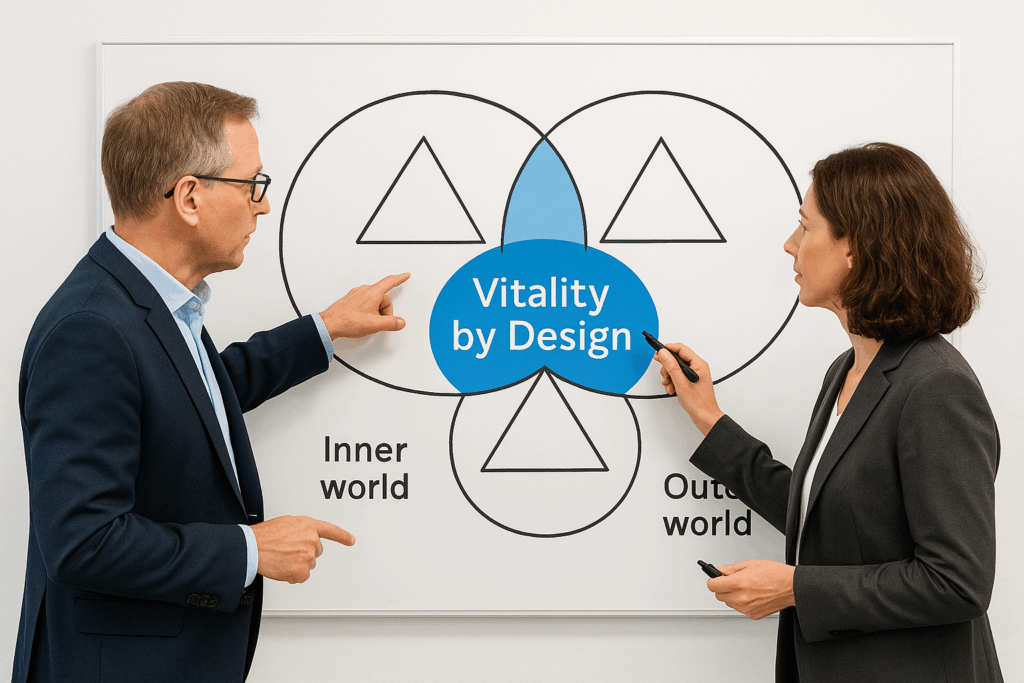
    The essence of this design process is alignment. Vitality emerges when the relationships between the organization, its tasks, and its people are internally balanced and mutually reinforcing. Yet vitality also depends on external alignment: when the the organization and its tasks are attuned to the needs, expectations, and support of the surrounding world.

    Vitality, therefore, is not only about coherence within the system but also about resonance with its environment. It thrives when there is fit both in the inner organizational triangle and its triangular relation with the outside world.

    Implications for Organizations

    Embedding vitality as a design principle generates a reinforcing cycle:

    • Performance grows as flow fuels creativity, motivation, and productivity.
    • Resilience strengthens as adaptability is amplified through alignment.
    • Health and sustainability improve, as vitality reduces the risk of illness and disengagement while extending employability.

    Vitality by Design is therefore both preventive and generative: it protects against dysfunction while creating the conditions for growth.

    Conclusion

    Vitality is not a side effect or an HR responsibility. It is the design principle that transforms health and adaptability into lasting performance and resilience. Organizations that embrace Vitality by Design unlock energy, innovation, and sustainability—not by chance, but by conscious design.

    Vitality by Design is the future of sustainable performance.

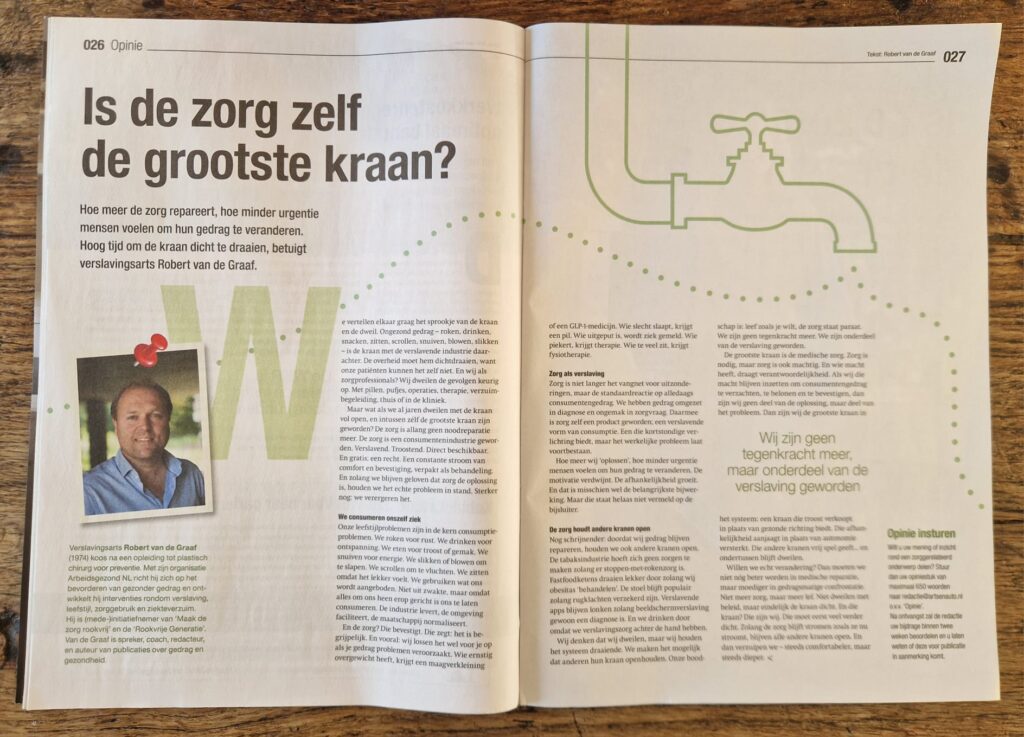
  • Is healthcare itself the biggest tap?

    J Health Behav Med Hist 2025-13.

    Is healthcare itself the biggest tap?

    Robert C. van de Graaf, MD, director
    MEDTCC Institute for Health, Behaviour, Medicine and its History, The Netherlands

    We love to tell each other the fairy tale of the tap and the mop.
    Unhealthy behaviour – smoking, drinking, snacking, sitting, scrolling, sniffing, smoking weed, popping pills – is the tap, with the addictive industry behind it. The government has to turn it off, because our patients cannot do it themselves. And we as healthcare professionals? We neatly mop up the consequences. With pills, puffs, surgeries, therapy, sick leave guidance, at home or in the clinic.

    But what if we have been mopping for years with the tap wide open, and in the meantime have ourselves become the biggest tap? Healthcare is no longer just an emergency repair. Healthcare has become a consumer industry. Addictive. Comforting. Instantly available. And free; a right. A constant stream of comfort and reassurance, packaged as treatment. And as long as we keep believing that healthcare is the solution, we sustain the real problem. Even worse: we make it worse.

    We consume ourselves sick
    Our lifestyle problems are, at their core, consumption problems. We smoke for calming down. We drink for relaxation. We eat for comfort or convenience. We sniff for energy. We pop pills or smoke weed to sleep. We scroll to escape. We sit because it feels good. We use what is offered to us. Not out of weakness, but because everything around us is designed to make us consume. The industry supplies, the environment facilitates, society normalizes.

    And healthcare? It reassures. It says: this is understandable. And above all: we’ll fix it for you if your behavior causes problems. Whoever has severe obesity gets gastric surgery or a GLP-1 drug. Whoever sleeps badly gets a pill. Whoever is exhausted is signed off sick. Whoever worries gets therapy. Whoever sits too much gets physiotherapy.

    Healthcare as addiction
    Healthcare is no longer the safety net for exceptions, but the standard response to everyday consumer behaviour. We have turned behaviour into diagnosis and discomfort into demand for care. In doing so, healthcare itself has become a product; an addictive form of consumption. One that offers short-term relief, but lets the real problem persist.

    The more we “solve,” the less urgency people feel to change their behaviour. Motivation disappears. Dependence grows. And that may well be the most important side effect. But unfortunately, it’s not listed in the leaflet.

    Healthcare keeps other taps open
    Even more painfully: because we keep repairing behaviour, we also keep other taps open. The tobacco industry need not worry as long as there is smoking cessation care. Fast food chains keep thriving as long as we “treat” obesity. The chair stays popular as long as back pain is insured. Addictive apps keep luring as long as screen addiction is simply a diagnosis. And we keep drinking because addiction care is waiting in the wings.

    We think we are mopping, but we are keeping the system running. We make it possible for others to keep their taps open. Our message is: live as you like, healthcare is ready. We are no longer a counterforce. We have become part of the addiction.

    The biggest tap is medical care. Care is necessary, but care is also powerful. And whoever holds power carries responsibility. If we keep using that power to soften, reward, and reassure consumer behavior, then we are not part of the solution, but part of the problem. Then we are the biggest tap in the system: a tap that sells comfort instead of offering healthy direction. That fuels dependence instead of strengthening autonomy. That gives other taps free rein… while continuing to mop.

    Do we truly want change? Then we must not become even better at medical repair, but braver in behavioural confrontation. Not more care, but more courage. Not mopping with policy, but finally turning off the tap. And that tap? That is us. That is what must be turned down much further first. As long as care keeps flowing the way it does now, all the other taps will stay open. And then we will drown – ever more comfortably, but ever deeper.

    Translation from:

    https://www.artsenauto.nl/is-de-zorg-zelf-de-grootste-kraan/